October 8, 2026
Drone-Based Seeding: A Practical Look at Precision Aerial Seeding for UK Farms
By @j3o8ojiniu
Why Drone-Based Seeding Is Gaining Ground in UK Agriculture
When I first watched a drone skim over a muddy, rain-soaked field in early spring, dropping seed pellets into ground that a tractor would have churned into ruts, I realised how far aerial seeding has come. Drone-based seeding is no longer a novelty or a demo-day gimmick. It has become a practical tool for farmers who need to get cover crops in at the right moment, overseed pastures without compaction, or establish grass on awkward slopes that machinery struggles to reach.
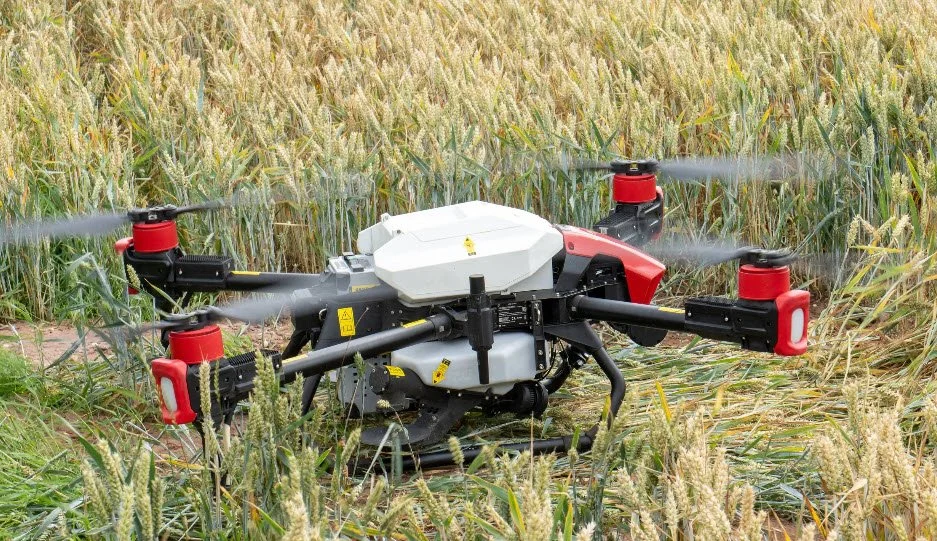
The appeal is simple: a multirotor like the DJI Agras T30 can cover uneven terrain quickly, carrying a hopper full of seed and dispensing it with surprising accuracy. Instead of waiting for the ground to dry enough for heavy equipment, you can fly the seed in when conditions are right for germination. That timing advantage alone can make the difference between a thick stand and a patchy failure.
How Drone Seeding Works in Practice
Most agricultural drones used for seeding are not the little camera quads you see at the park. They are purpose-built spreading machines, often with a central hopper and a spinning disc or pneumatic system that flings seed out in a controlled pattern. The XAG and DJI Agras ranges are the most common in the UK, with the Agras T30 being a favourite for its payload capacity and variable rate application capabilities.
Variable rate application is where drones really shine. You can load a prescription map into the flight controller, and the drone will adjust the seeding rate on the fly as it moves across the field. A patch of thin, sandy soil gets more seed; a heavy clay area with good moisture gets less. This is precision agriculture at its most direct, and it saves both seed and money.
Geotagging plays a big role too. Every drop is recorded with a GPS timestamp, so at the end of the job you have a detailed map of what went where. That data is useful for later assessments, for record-keeping, and for planning next season. It also gives you a clear picture of whether the seeding actually worked, especially if you combine it with aerial imagery a few weeks later.
What Drone Seeding Is Good For (and What It Is Not)
Drone-based seeding is not a replacement for a conventional drill on a large, flat, open field. If you are planting a 50-hectare block of barley, a tractor-drawn drill will still be faster and cheaper per hectare. But for the jobs that tractors do poorly, drones are genuinely transformative.
Consider the classic problem of establishing a cover crop after harvest. The window is tight, the soil is often wet, and driving over it can cause compaction that ruins the structure you are trying to improve. A drone can fly in with a mix of radish, vetch, and rye, dropping seed pellets into the stubble without ever touching the ground. That protects soil health and gets the crop going weeks earlier than waiting for a dry spell.
Another strong use case is reseeding hill pasture or steep banks where a tractor is dangerous or simply cannot go. I have seen drone crews working on a 40-degree slope that had eroded after a wet winter. The seed went on evenly, and within a month the green lines were visible from the lane below.
But there are limitations. Drone seeding is not ideal for large-seeded crops like beans or peas, because the hopper capacity is limited and the seed weight reduces flight time. It is also less effective in very windy conditions, where the seed pattern can drift. And the upfront cost of a capable system, or the service fee from an agriculture drone services provider, is not trivial. You have to weigh that against the value of timely establishment and the avoidance of soil damage.
Regenerative Agriculture and the Rise of Seed Pellets
The growth of drone-based seeding is closely tied to the regenerative agriculture movement. Farmers are increasingly looking to keep living roots in the soil for as long as possible, and that means planting cover crops more often, on more acres, with less disturbance. Drones fit that philosophy perfectly because they allow you to seed without tilling and without compaction.
Seed pellets have made aerial seeding more reliable. Bare seed can be blown off target or fail to make good soil contact on hard ground. Pelleting coats the seed in a clay or compost-based layer that adds weight, improves moisture retention, and can include beneficial microbes or nutrients. Companies like DroneSeed have been refining this approach for forestry and ecological restoration, and the same principles apply to agricultural cover crops. A pelletised seed is heavier, so it flies straighter through the air and settles into the sward better.
There is also a growing interest in using drones for direct seeding of trees and shrubs on farmland, both for shelter belts and for carbon sequestration projects. Organisations like Grassroots Carbon are working on methodologies to credit soil carbon and vegetation establishment, and drones are one of the tools that can make those projects viable at scale.
Regulation and Practical Considerations in the UK
Flying a drone for commercial purposes in the UK is not as simple as buying a quad and heading out to the field. The UK Civil Aviation Authority has clear rules. You need to operate within visual line of sight unless you have specific permissions, and you must hold the relevant qualifications. For a heavy multirotor like the Agras T30, which can weigh over 20 kg with a full hopper, you are looking at a CAA permission for aerial work and possibly an operational safety case.
That is why many farmers choose to hire a specialist contractor rather than buy their own drone. A company offering agriculture drone services will have the insurance, the pilot qualifications, and the experience to handle the regulatory side. It also means you can access expensive kit like the DJI Agras or XAG models without a large capital outlay.
When you are planning a drone seeding job, there are a few practical things to get right. First, check the weather. Wind speed and direction matter, and most operators will not fly in more than about 15-20 km/h of wind. Second, make sure the seed is suitable for aerial application. Some seeds are too fluffy or too large to flow through the spreading mechanism. Third, think about the timing. Seeding into dry soil with no rain in the forecast is a waste of money. A light shower within a day or two of application makes all the difference.
What the Data Shows: Results and Comparisons
Independent trials and farmer experiences have shown that drone seeding can produce comparable establishment rates to conventional methods, especially for small-seeded crops like grasses and clovers. The key is to match the seeding rate to the conditions and to use good quality seed pellets. Some studies have found that drone seeding can actually outperform broadcast seeding by a tractor because the distribution is more uniform and there is no wheel track compaction.
One of the most useful features on modern drones is the ability to create accurate flight paths and to adjust the spread pattern in real time. The DJI Agras T30, for instance, has a dual atomised spraying system that can also be used for liquid fertiliser or biostimulants, but for seeding you switch to the spreader attachment. The XAG P30 and V40 models offer similar capabilities, with a focus on fully autonomous operation and mapping.
There is also a growing ecosystem of software that ties into these drones. You can import field boundaries, generate prescription maps, and even use RFID tags on individual seed bags to track which batch went where. That kind of traceability is valuable for certification schemes and for your own records.
The Future of Aerial Seeding in the UK
I expect drone-based seeding to become more common as the technology matures and as more farmers see it working on real farms. The cost per hectare is still higher than a conventional drill, but the benefits in terms of soil health, timeliness, and access to difficult ground often outweigh the extra expense. As battery technology improves and hopper sizes grow, the economic case will only get stronger.
There are already companies in the UK offering drone seeding as part of a broader package of services, including aerial spraying and mapping. Aeroagri, for example, is one of the names that comes up in conversations about professional drone services for agriculture, and they and others like them are helping to push the practice forward. Kespry and SenseFly are more known for surveying and mapping, but they show how the drone ecosystem is expanding beyond just taking pictures.
For a farmer thinking about trying drone-based seeding, my advice is to start small. Pick a field that is difficult to access or a cover crop that you would normally skip because of wet conditions. Find a reputable service provider, ask about their experience and insurance, and ask to see results from similar jobs. Then walk the field after the first decent rain and dig up a few seeds to check they are germinating.
There is a learning curve, and not every job will be a perfect success. But the potential is real. When you can seed a field of steep, wet pasture in twenty minutes without leaving a single wheel mark, you start to see why so many people are talking about drones as a genuine tool for regenerative farming. It is not about replacing the tractor; it is about doing the jobs that the tractor cannot do well, and doing them at the right time.
Drone-based seeding is here to stay, and for UK farms that want to protect their soil, cut costs, and be more responsive to weather windows, it is worth a serious look. The technology is proven, the regulators are engaged, and the farmers who are using it are seeing benefits that go beyond the field map. It is a quiet revolution, one flight at a time.
❧